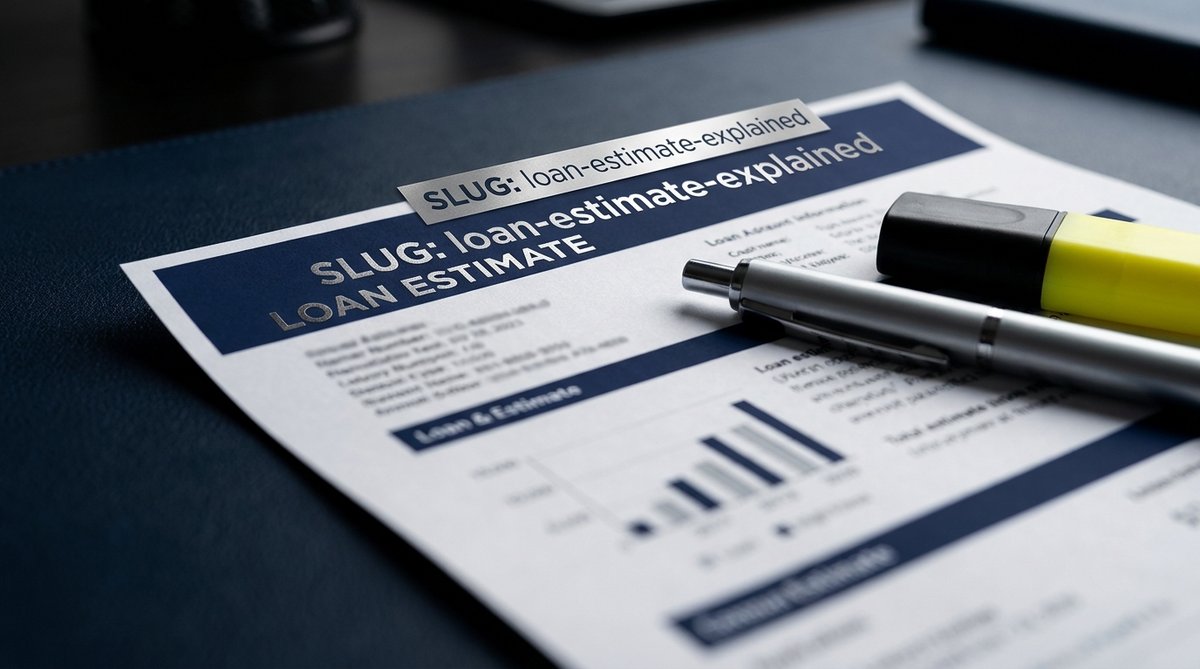
There's one document in the entire mortgage process that decides what you actually pay — and most Realtors, and plenty of buyers, can't read it past page one. It's called the Loan Estimate (LE), and the federal government designed it specifically so you could compare offers apples-to-apples. The catch? Nobody teaches you where to look. Let me decode all three pages, then give you a 30-second gut check.
What the Loan Estimate even is
The Loan Estimate is a standardized three-page form a lender is generally required to give you within three business days of your application. Because the format is identical from lender to lender, you can lay two of them side by side and they'll line up — if you know which lines matter.
Page 1 — the snapshot
Page 1 is the at-a-glance summary: your loan terms (amount, interest rate, monthly principal & interest, and whether any of those can change), your projected payments over time, and a box for costs at closing — your estimated closing costs and your estimated cash to close. Great for orientation. But the real story is on page 2.
Page 2 — where the money hides
This is the page that decides what you pay, and it's broken into labeled sections.
| Section | What it is | Can you shop it? |
|---|---|---|
| A — Origination Charges | The lender's own fees: points, application, underwriting. | This is the section to scrutinize |
| B — Services You Cannot Shop | Lender-selected services like the appraisal. | No |
| C — Services You CAN Shop | Title, settlement, and similar services. | Yes |
| Taxes, prepaids & escrow | Property taxes, prepaid interest, homeowners insurance, escrow setup. | Largely fixed by your situation |
Section A is where you look first. It's the lender's controllable fee, and it's the cleanest comparison between two offers. Section C is your leverage — those are services you're allowed to shop, so you don't have to accept the lender's default providers.
Page 3 — APR, TIP, and the fine print
Page 3 holds two numbers worth understanding. The APR (Annual Percentage Rate) rolls certain fees into a single yearly percentage, which is why it's usually higher than your note rate — it's an attempt at a total-cost-of-credit number. The Total Interest Percentage (TIP) shows how much interest you'd pay over the full loan term as a percentage of the amount borrowed. Both are useful context, though neither is a substitute for comparing the actual cash to close.
Two diners order the same $30 entrée (the rate). But one check tacks on a "service fee," a "kitchen fee," and a "linen charge" (Section A); the other doesn't. The menu price looked identical — the total wasn't. The Loan Estimate is your itemized check. Read past the entrée price and you'll see who's quietly padding the bill.
The 30-second gut check
Here's the move that cuts through everything: get two Loan Estimates quoted at the same interest rate, then compare just two things — Section A (origination) and the total cash to close. Holding the rate equal removes the biggest variable, so whoever has the lower Section A and lower cash to close is genuinely the better deal. No spreadsheet required.
Questions to ask when you get an LE
- "Can you quote this at the same rate as the other lender so I can compare Section A?"
- "What's in my Section A, line by line?"
- "Which Section C services can I shop, and do you have a provider list?"
- "What's my total cash to close, and what could change it?"
Want me to decode YOUR Loan Estimate?
Grab the free Stuck Homeowner's Playbook, or bring your LE and I'll walk you through it section by section.
Get the Free Playbook →Frequently asked questions
Related free tools: Mortgage Payment + MI calculator · the full Playbook · all calculators
Educational content only — not financial, mortgage, or legal advice, and not a loan offer or solicitation. Timothy George is the founder of Infinity Financial Mortgage Corporation who has been in the mortgage business since 2007; this is independent educational material and he is not acting as a currently-licensed loan originator. Forms, fees, and rules vary by lender and program — confirm specifics with a currently-licensed professional before you act.